
Trials and Triumphs of an 82 Mile Kayak Trip up the Tennessee RiverLine
(Tyler Kirkendall was part of the RiverLine team for just over a year during his service as an AmeriCorp service member . He joined the Paddle Georgia trip to capture the experience, vlogging each day about the experience, capturing content to document it, and writing about his experience.)
From feeling like I had left the world I knew behind to deep conversations with new friends and achieving a once-unfathomable goal–paddling 82 miles from Ringgold, GA, to Stevenson, AL–Paddle Georgia was a journey I will never forget.
Paddle Georgia 2025, hosted by Georgia Rivers, sent even veteran participants of its annual adventure to new territory: the Tennessee River. Paddling from Chickamauga Creek in Georgia, up the Tennessee RiverLine via Chattanooga, TN, to end on Crow Creek in Stevenson, AL, seemed like a daunting task even just glancing at the map.
I had underestimated the spirit, endurance, and pride that comes along with paddling the full length of the trip, but I don’t want to get ahead of myself so I’ll start back at the start.
Day 1: Starting the Journey in Ringgold, GA
Showing up at camp, the first evening (June 15) was relatively mellow while everyone set up their tents or RVs and dropped their boats off at the launch for the next morning. Many were reconnecting with friends they hadn’t seen since the last Paddle Georgia, while others were getting to know their new neighbors setting up camp in the rain.
Dinner took place in the arena at Camp Jordan, where caterers had set up a serving table with a hot meal; the first night, barbecue was on the menu. The long line set the tone for the week’s dinners, and as the hour wait to the service table passed, people were flying in and out of line squealing when they saw their friends as if it was the first day of summer camp. The only difference was these folks were middle-aged and older for the most part. I heard one woman reconnecting with an old Paddle Georgia pal say that “the thrill (of arriving) still hasn’t worn off” as she sped around the arena with seemingly no destination in mind.
Paddle Georgia’s participation figures (including those who chose to only come for two- or three-day paddles) this year counted about 400 participants.
Joe Cook, the humble and faithful leader of Paddle Georgia for its entire 20-year existence, began the project with the idea of showing people not just the most beautiful few miles of Georgia’s rivers, but long stretches of different watersheds so paddlers could see the variety of landscapes from industrial sites, to residential parks, to stunning gorges and wildlife refuges. The trip this year would accomplish this goal in flying colors across 55 miles of the Tennessee RiverLine, as well as 27 miles through Chickamauga Creek wilderness.
The Georgia Rivers staff really showed off their experience with the safety-centric introduction after dinner the first night, with plenty of stories to back up their reasoning for even the most menial-seeming protocols. This expertise showed throughout the week, as even with hundreds of paddlers everyone was kept in line and there were no major accidents or incidents.
Part of the safety introduction included advice on navigating the main stem of the Tennessee River, which got people feeling both excited and a little nervous. Being in the minority for having paddled several sections of the RiverLine already, I kept joking that I was the unofficial “barges aren't going to sneak up on you and flip over your kayak” guy.
Day 2: Chickamauga Creek: Scenic, Technical, and Humbling
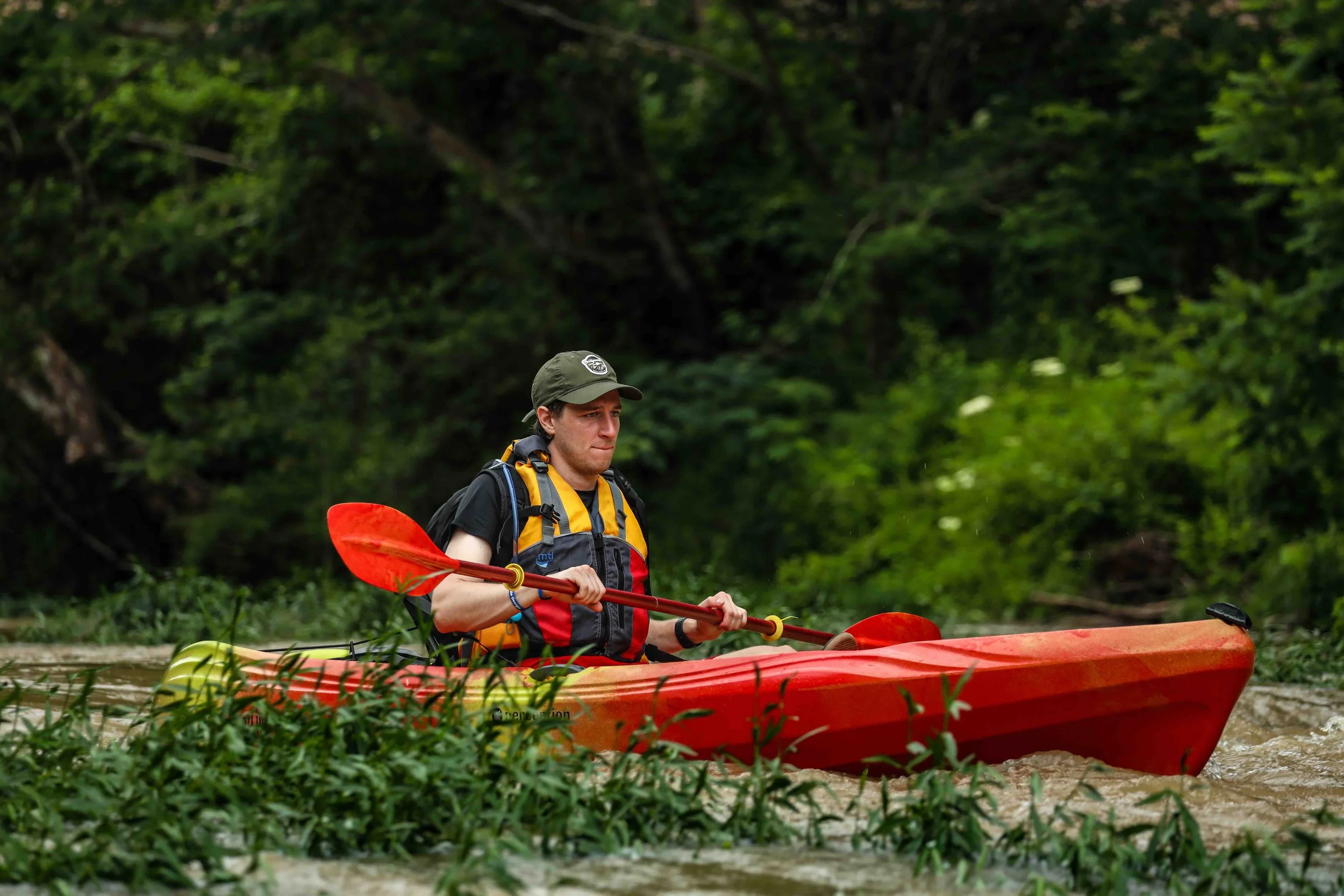
Traffic on the Tennessee wouldn’t come until later, however, as we began the first day of paddling with 10 miles on Chickamauga Creek. The first day on the water would prove to be the most difficult from a technical standpoint, as we had to navigate shoals and various drops through relatively fast water. At one particularly difficult drop, a trio of spectators in lawn chairs held up paper signs to give paddlers scores on their navigation techniques.
The water was brown from runoff thanks to the past week’s worth of storms, and the tree canopy reaching up and over both sides of the creek—as well as the fact that everyone around me was new to me–had me feeling like I had gone to another planet.
The experience at the beginning was a little overwhelming, as I hadn’t yet established strong enough relationships to have anyone who grounded me and who I felt like I could talk to on a personal level about what we were doing. Small talk surely happened all along the way, but it would take time to find “my people” and develop a meaningful rapport with others. It certainly didn’t help that I am terrible at remembering names, as well as the fact that most people had big hats and sunglasses concealing their faces to protect from the sun.
The turtles throughout the creek were the stars of the show, with plenty of them taking over large rocks to dry off their shells in the sun. They were a big topic of discussion through dinner and the bus ride back to camp after the first day.
Georgia Rivers also hired a naturalist to come along for the trip and lead a discussion of the wildlife seen each day. The naturalist’s charisma showed each night, with his imitations of frog sounds quickly making him the second-ranked celebrity at camp only behind the trip’s leader. He helped everyone identify the turtles, birds, and frogs they saw along the creek.
The challenges that come along with sending a group of more than 300 paddlers/day through the same waterway were part of what made each day exciting. There was always something that Georgia Rivers rigged up that became a great icebreaker for anticipatory paddlers. On this day, the rigging was a hand-made bamboo slide to send everyone's kayaks over a running dam that would otherwise be impassible for boats.
The slide worked perfectly, with paddlers having to work to keep their boats still in the listing water while they waited their turn to get out and send their craft down the dam. I happened to bump into a couple employees from the city of Chattanooga during this obstacle, and they said they wished they could keep the chute up permanently since the dam has always been a barrier for paddlers of Chickamauga Creek.
After loading all the boats onto the shore, it was time to wait in the sun for buses to arrive to take everyone back to camp. It was hot and there wasn’t much shade where the bus was pulling up to, so it was another opportunity to mingle amidst the hardships created by the scale of the trip.
Day 3: Continuing Down the Creek
By the arrival of day three, I had gotten comfortable sleeping at camp and keeping up with the schedule we had each day.
But just like that, it was time to leave our collective comfort zones. Camp Jordan is a public park, so everyone had to pack up camp before we left for the paddle since there would no longer be security to watch over our sites.
Knowing this was the case, going to bed as early as possible was a must. There was surprisingly little activity throughout camp each night; there were no bonfires or tailgate-style scenes with adult beverages as I had expected.
In fact, I got the best sleep of my life throughout the trip on account of how tiring and full each day was. I am normally a light sleeper and once something pulls me out of my slumber I am alert and awake for good, but each night if I woke up I was back out in a moment.
Waking up and taking down the tent was not all too difficult, and I had learned the strategic advantage of being the last person served breakfast; no time in line meant I had more time to sleep and get ready for the day. No shame in being the last person on the bus.
The second day of paddling was about the same as the first, only it was six miles longer and included a pitstop back at Camp Jordan. It felt awesome to get out at camp, both to stretch my legs and feel a sense of accomplishment that we had covered so much ground.
The water was still murky and the forest still dense, so the sense of isolation persisted, but this time with more relatable side conversations and a growing sense of community.
Day three’s obstacle came in the form of a sewer pipe that needed to be crossed, and of course Georgia Rivers had a solution. Volunteers helped participants get out of their boats and portage them down to the other side. The volume of hands ready to help was, yet again, evidence of the good-natured community present at Paddle Georgia. It was astounding how many people were willing to use their energy volunteering given the fact that slinging boats around is no easy task.
One of the cool parts about the day’s paddle was passing right by the boundary of the Chattanooga Airport, where planes were flying very low over the creek and there was no mistaking the spot they were about to touch down.
Paddling a marathon in the first two days and setting up camp left everyone pretty tired, so the evening’s programming after dinner wrapped up quickly and everyone was off to bed. The new campsite was Tennessee River Place, which everyone seemed to favor over Camp Jordan for its scenic beauty, proximity to the river, and privacy from the public.
The next stretch of the trip would prove to be the most beautiful and relaxing, but that didn’t mean it came without challenges. Read on to find out about the seismic shift in vibes from the wilderness to the industrial cityscapes of Chattanooga!
Day 4: From Wilderness to Cityscapes
The otherworldly/isolated feeling wouldn’t last me through the end of the fourth day paddling, as a few miles in we hit a Chattanooga park which I had spent an afternoon skateboarding at a month back.
Once I got to the mouth of the creek where it met the Tennessee, the rush of air off the river stimulated my senses with a similar feeling to walking into my grandma’s kitchen. The cooler air hit my face and I felt at home in an instant, knowing both on a logical and subconscious level that I had reached familiar territory.
Greeted by what I guessed and later confirmed was Chattanooga Country Club, the landscape changed quickly as the wide open river was lined with residential and industrial spaces; the new sights were, for me, a welcome return to society. Though I often seek refuge in wild spaces to get a break from daily life, it was funny to feel myself seeking comfort in built spaces since I had become so used to the sights of untamed wilderness along the creek’s bends.
By the ends of days three and four, I had developed some relationships with fellow paddlers and campers that would make the trip much more enjoyable. Between bus rides to and from boat launches and campsites, long dinner lines, and after-dinner educational activities, there were plenty of opportunities to mingle and get to know those around you.
The best opportunities for socializing were easily the days on the water themselves. Cook had said that another tentpole of Paddle Georgia’s mission statement was to get people to connect over a common goal and the hardships that come along with a difficult journey, and this mission was also well-accomplished in my experience.
Quick check-ins with people always proved to supply friendly and interesting perspectives until your paddling paces were out-of-sync and one person unceremoniously ended the conversation while pressing ahead. It never seemed offensive to leave the conversation in this way, which felt like a bit of a break from the typical Southern politeness that was omnipresent throughout the week thanks to its mostly Georgia-based participants.
Everyone was given the chance to appreciate our return to society with a free night to roam Chattanooga. Excursions including the Tennessee Aquarium were popular for participants, and the city was new to a lot of Georgia-based folks. I elected to go grab a beer and a hot beef sandwich from a bar with a few new friends.
Day 5: Rain, Rain, Stay a While
This day was defined by its industrial sites and rainfall, though neither were as unpleasant as they may sound. It was also litter pickup day, for which Paddle Georgia participants made a very impressive effort as literal boatloads of trash were picked off shorelines despite the rain.
Before making it down to the water, though, we had to wait several hours for a storm to pass. The lightning and thunder let up, but the rain lasted on-and-off throughout the day’s journey.
The cool weather was a great change of pace, and the rain and overcast conditions were a welcome respite from the beating sun that persisted each day before and after this one. I had also established a really solid relationship with a family of three (a father and his son and daughter from Atlanta) and a man around my age by this point, so I spent the whole paddle talking with my new friends and it flew by so I never felt tired. To finish, we pulled right up to Tennessee River Place, where they were “rolling out the green carpet,” a fresh layer of sod over the muddy, tamped down grasses to the campgrounds.
The night was dedicated to visiting Chattanooga area attractions, and I joined a group of participants at Ruby Falls, which was corny but certainly a beautiful and rare natural attraction. I am generally afraid of caves and tighter spaces, but Ruby Falls sat perfectly on the edge of my comfort zone.
The most amazing thing about this day was standing atop the castle-like Ruby Falls entrance I’d seen from the water, and realizing I had paddled around the bends of the river as far as the eye could see. I’m sure I will be reminded of that sense of accomplishment each time I return to Chattanooga.
Day 6: The Tennessee River Gorge: A Highlight Reel
Many expected this day to be the most scenic of the trip, and I think I speak for everyone when I say it certainly was.
Staggering mountain views from throughout Tennessee River Gorge were everything they were hyped up to be, and the weather complemented the landscape perfectly. Sunny and warm with puffy clouds across the sky, there was no better way to enjoy such a beautiful day than paddling 13 miles with plenty of wild mini-beaches to land on for a quiet break with some privacy.
Surprisingly, wildlife seemed more abundant (or at least less shy) along the river than on Chickamauga, especially later on once we got to Tennessee River Gorge. Osprey nests, sunbathing turtles, and even owls hooting across wide expanses were seen and heard by many on the trip, which really showcased how even in human-altered spaces animals can find a way to thrive.
The long conversations with people who I really connected with, however, were what made the entire trip worth it. From conversations about intentionality, respect, and lessons learned with a high school teacher, to a seasoned adventurer’s revelations from a near-death experience, I met many travellers who–like myself–weren’t afraid to spill their guts to someone who was a stranger when we got on the water.
These conversations were especially vital at the tail ends of longer days paddling, often making the last four or five miles feel like a breeze compared to the ten that preceded.
This day was another where we had to move camp yet again, and many felt reluctant since Tennessee River Place had been spectacular. We were headed to northern Alabama to stay at Stevenson City Park Campground.
Shortly after setting up camp, I had to eat dinner quickly to make it to Nickajack Cave with a group of other participants to see its famous bats-en-masse.
Though I did not much feel like paddling anymore, I had heard many times that the bats were not to be missed. Though I was foolishly expecting a Batman Begins-style swarm of bats all emerging at once, I was not disappointed by the steadier flow of bats that emerged over the course of the sunset.
Truly a marvel of the Tennessee RiverLine, there was a sizable group of non-Paddle Georgia spectators who made their way to the mouth of the cave to see thousands of endangered gray bats head out for their evening feast. It was worth the trip and the extra paddling for the sunset alone, and appearances from several beavers made it even better.
Doubt was starting to creep in as we got set for the last two paddles. These would prove even more taxing than the first two days’ collective marathon, as the last two days we were scheduled to press on for 30 miles total. Read on in part 3 to see how my new friends helped push me to the finish line!
Day 7: Muscle Fatigue, Sunburns, and Self-Doubt
On the second to last day, the paddling journey would bring us through Nickajack Dam’s lock and past South Pittsburg, TN, then crossing the border into Alabama to finish at Bridgeport. This day was my first time ever experiencing Alabama’s heat and humidity, and it was a doozy.
We had 13 miles on the water, all while looking down the barrel at 16 more miles for the next and final day.
After five days in a row paddling, my body certainly felt tired on the last two days. For reference I am 26 years old, in moderately good shape thanks to hiking ventures several times a week, and I don’t think I had paddled on two consecutive days for about a decade before this trip.
To my surprise, the most taxed parts of my body weren’t necessarily my arms or core, but my hands and my back. Having to hold onto my metal paddle with just the grip strength from my wet, blistered (on the front and back) hands proved to be really difficult on the final days. As my form worsened from weariness, so did the condition of the muscles around my lower spine.
Around busier areas like South Pittsburg, and through stretches of the breathtaking Tennessee River Gorge, there was a lot more traffic with pleasure boaters speeding through and whipping up a wake that often stopped us paddlers in our tracks to brace for the waves. These breaks in progress would come and go quickly, but it could be frustrating to have to turn and regain speed after losing all your momentum.
Along the Tennessee River, there are some considerable stretches without organized put-in and take-out spots, which meant that making our own places to take a break was almost essential. One thing I gradually learned about myself is the fact that I have really underestimated the power of a break for my entire life. On several occasions, the beating sun and long road ahead really made me want to abandon the mission, but sitting with my eyes closed in the shade and being off the hard seat of my kayak for anywhere between three and 20 minutes consistently turned around my mood and belief in myself. A well-timed pack of fruit snacks or mouthful of beef jerky to break down came in handy each day.
At the end of the second-to-last paddle, the RiverTowns Local Leadership Team of Bridgeport, AL, was waiting for paddlers with hot dogs, refreshments, chips, and cookies, which was a heartwarming and rejuvenating gesture. They were not asked to be there in an official capacity, yet they went all-out setting up tents which celebrated local history and showcased tons of cool artifacts to check out.
For the first several days, there was a woman who consistently gave me a hard time about wearing short sleeves since they didn’t provide UV protection, saying that I would end up with skin cancer if I didn’t cover up soon. After heeding her advice for the back half of the week (I had been saving my long sleeves figuring I’d need them late in the game), still nothing was preventing my hands from taking on a harsh burn and beginning to bubble up from long days in the sun. Not even the full bottle of sunscreen I used up through the week could’ve saved me.
On the last night, every conversation was the same: “Are you going to finish the paddle tomorrow?” “I don’t want to, but I have to. It’s a point of pride.”
For my concerned friend and I, the conversation was a little different as I showed her the blisters on my hands and asked if I could borrow her spare gloves. She didn’t even hesitate. She went and grabbed them and really saved my ability to paddle the last 16 miles after I had gotten to a point where I’d even typed out and deleted a message to my boss saying I might not make the last paddle. To the friend that I didn’t see after the last paddle: I’m sorry I couldn’t find you, I left your gloves in the lost and found.
Day 8: The Final Stretch and a Triumph Worth Celebrating
To start the final day, I was feeling very energized knowing that it would be the final day on the water and the finish line was within reach.
Paddling each day had provided the challenge that everyone expected, especially since the flow of the Tennessee River was less than that of the rivers most participants had come to know. Aside from six- and seven-day paddles on Wednesday and Thursday respectively, each day we paddled more than ten miles, including two days going 16 (one being this final day).
Just a few miles into the last day on the water, I achieved the feeling that people take on adventures like this for. I felt an overwhelming sense of peace and accomplishment knowing that despite the 93 degree weather and 75% humidity, I was going to finish the trip. I paused for a moment, looked around at the now-familiar faces that surrounded me, and couldn’t stop smiling as I simply enjoyed the moment and felt tremendous gratitude for the opportunity.
No feeling of hunger or lack of hydration (two Gatorades and three big bottles of water were not enough) would stop me after this point. Not even the four miles of shadeless, eelgrass-stricken creek that wrapped up the day’s 16-mile trek were enough to discourage the group from completing what we all set out to do.
Upon returning, we were greeted by cheering Georgia Rivers staff and given free ice cream or snow cones; I feel like I’ll remember the taste of my tropical snow cone with sweet cream forever. I also won't forget the five catfish fillets, cup of coleslaw, and basket of fries I inhaled as quickly as I could before I even thought about packing up camp.
Packing up and hitting the road was seamless thanks to the help I got from my new companions, and I couldn’t wait to get home to a shower I didn’t have to leave shoes on for.
Throughout the week, veterans of Paddle Georgia kept asking me if I would want to return next year. Up until the last day, my answer was a polite, lukewarm “maybe.” After finishing the final day’s paddle and going home knowing I’d miss the friends I made on the trip, I’ll say I would absolutely do it again.