
One River, One Big Idea
Ten years ago, a UT student was asked to imagine the future of the Tennessee River Valley. Her vision, to reconnect people to the river, has grown into the Tennessee RiverLine, a regional initiative connecting communities across 652 miles and four states.
Journey Roth grew up on the water.
Swimming. Tubing. Fishing. Riding jet skis. An East Tennessee native, she got her boating license at 15. When she thinks back to her childhood, some of the happiest memories involve a lake or river.
So when Roth arrived on Rocky Top to study architecture, the Tennessee River running alongside campus was already part of a landscape she knew and loved.
Roth was a senior in 2016 when she enrolled in a new interdisciplinary course offered through the School of Landscape Architecture called River Studio. Professor Brad Collett gave the students a broad assignment: Consider how the Tennessee River Valley could carry its legacy of regionalism, innovation, and leadership into the 21st century.
The assignment was open-ended. And Collett encouraged students to think big.
“We didn’t have an end product in mind,” he said. “I think that allows for beautiful things to happen.”
Seeing the River as a Whole
Before the 12 students could imagine the Tennessee River’s future, Collett wanted them to understand the river as a place. The class spent five days traveling from Knoxville to Paducah, Kentucky, following the river as closely as possible by road.
“When you live in Knoxville, the river is very present, but it’s present as an episode where you see it crossing over a bridge or driving by,” Collett said. “But to see the river as a continuous, connected landscape is quite transformational.”
Along the way, students met with community leaders and studied the region’s history, infrastructure, power, transportation, and environmental changes. They also began to see how different communities related to the same river.
“We stopped at museums, the aquarium, talked with farmers, and just had a lot of conversations with people who one way or another were connected to the river,” Roth said.
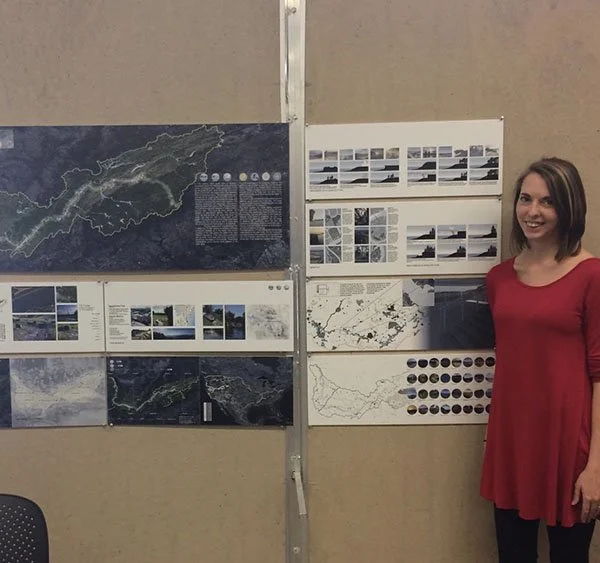
The trip became the foundation of Roth’s project. She started mapping what was already there: trails, parks, historic sites, and communities. Instead of seeing them as isolated destinations, she began thinking about what might happen if they could be experienced as pieces of something larger.
In a reflection written afterward, she summed up the trip’s central lesson in one word: collaboration.
“After seeing the beauty and challenges the river offers, the main thing is using the knowledge we have gained to shape what we can improve,” she wrote. “The only way we will be able to make real change is through collaborating and learning from each other.”
Reconnecting What Was Already There
Roth called her proposal ReConnect.
The name captured her vision. Reconnect communities to the river, reconnect people to its landscape and resources, and reconnect the present-day Tennessee Valley to its history.
That history runs deep. The Tennessee River has been central to some of the region’s most consequential moments, from the Trail of Tears and the Battle of Shiloh to the TVA’s transformation of the river system and its role in World War II.
For Roth, those stories were part of the river’s landscape.
“If people understand what happened in a place, they experience that landscape differently,” she said. “Architecture has the power to connect people to those stories, so it just made sense to build on that connection.”
Drawing inspiration from the Appalachian Trail, Roth also imagined a long-distance trail system that could give the Tennessee River Valley a shared identity. She proposed a 20-foot greenway buffer along the river and pavilions that could serve as gathering, rest, and educational spaces. She saw the river as a way to bridge communities, which in turn could give residents a greater stake in protecting it.
“The project was more big-picture than what I was used to,” said Roth. “But I think my realistic way of thinking helped me get to where it ended up. I was granular in my approach instead of thinking about something more theoretical.”
It helped that much of what she imagined was already there. Parks were there. Trails were there. Communities were there.
The opportunity was to connect them.
From Studio to Something More
The semester concluded with a presentation of all the projects to representatives connected to the Tennessee River Valley, including Tennessee Valley Authority (TVA), tourism organizations, and state trails and greenways officials.
One student proposed building awareness around freshwater mussels and their natural filtration abilities, while another reimagined abandoned industrial sites along the river as opportunities for reclamation and adventure tourism.
But it was Roth’s proposal that stood out.
“It was the most attention I ever received in school,” she said. “They really gravitated toward my project.”
Collett believed Roth’s work resonated because it grew from what she had seen and experienced.
“It was authentic because she, like all the students, was convicted about her ideas after witnessing the challenges and opportunity for herself,” he said.
Rather than creating something new, Roth’s proposal centered on connecting people to what was already in place.
“There was already layers of richness that her project was building on,” Collett said. “And it aligned with the priorities and work already underway of regional organizations like TVA and Tennessee State Parks. So they wanted to be a part of that development.”
Roth graduated that spring and moved to Philadelphia for her first architecture job. While she left Knoxville, the idea, not unlike the Tennessee River, kept moving forward.
Building a Vision
Collett utilized subsequent River Studio courses to develop Roth’s idea, using the river as a laboratory for urban and community design, economic development, and recreation. The original concept of a land-based trail gradually became a bold vision for a 1.2-million-acre ‘River Park’ that connects outdoor recreation experiences on the river, adjacent public lands, and in river communities.
The School of Landscape Architecture provided faculty and student support for the project, while seed funding from UT ORNL Governor’s Chair for Energy and Urbanism and TVA, along with technical assistance from National Park Service planners and a consortium of regional partners, helped turn the ideas into a workable plan.
But the scope of work soon became too big to rely on faculty and students alone.
“We needed the university’s support to become a sustainable outreach initiative where our main source of capacity wasn’t graduating every year,” Collett said. “Research from the pilot program conducted in 2019 helped define what would be needed to make the vision a reality.”
Recreation, planning and design, and communications and marketing emerged as gaps in community capacity that the initiative could fill through UT’s land grant mission. By May 2021, with UT Knoxville and TVA as the initiative’s principal partners, the Tennessee RiverLine had transitioned from a project primarily in the School of Landscape Architecture to a university-supported program led by a team of UT Extension professionals at the UT Institute of Agriculture. Its public launch in Knoxville established the RiverLine as a regional initiative.
School of Landscape Architecture Director and Associate Professor Gale Fulton said the evolution of the RiverLine is a testament to experiential learning.
“It can change the way students think about landscape architecture, and sometimes, as we’ve seen with the RiverLine, an idea that starts in a studio can grow into something much bigger,” he said. “There is real value in students taking what they learn and applying it to a real place with real challenges. It’s the kind of learning that can’t come from a classroom or textbook.”
RiverLine Ten Years Later
A decade after Roth first imagined it as a student project, the Tennessee RiverLine has grown into a network of outdoor recreation experiences on and along the 652-mile Tennessee River in Tennessee, Alabama, Mississippi, and Kentucky. People can paddle, hike, bike, fish, birdwatch, and camp along the way, while communities develop riverfront trails, parks, access points, and gathering spaces. Through its RiverTowns Program, local leaders and residents identify priorities for their riverfronts, while the RiverLine team helps turn those ideas into activities and places people can experience and enjoy. The work looks different from place to place, but the goal is the same: connect people to the river.
In 2024, Collett stepped away from his faculty role to become the RiverLine’s first full-time executive director. After years of developing the idea through teaching, research, and university partnerships, he was ready to make the RiverLine his sole focus.
“I’ve come back to this place through my passion for design, landscape architecture, and the environment. Through the Tennessee RiverLine, I have the opportunity to help showcase and inspire stewardship of this tremendous resource,” he said.
In some ways, the transition brought Collett full circle and back to an interest that began when he was a child.
“It actually goes back to growing up wanting to be a park ranger. I’ve always had a deep affinity for the environment and recreation. I was a Boy Scout, an Eagle Scout, and I learned early on the importance of caring for these places,” he said.
For Roth, the project she imagined as a student has become part of her own story.
“I’m proud of it,” she said. “It’s fantastic that something I came up with as a student has actually grown into something real.”
Today, Roth works for Progressive Companies, a midsize, full-service firm in Charlotte, North Carolina, though she can imagine at some point returning to East Tennessee. One item high on her bucket list: kayaking the full length of the Tennessee RiverLine.
“I feel very connected to the landscape of Tennessee, and it’s really exciting to know one day my daughter is going to be able to see these places actually exist and hopefully think of me.”