
Q&A: Dr. Carrie Crawford Reflects on the Tennessee RiverLine's History
As we celebrate five years of the RiverLine and ten years of research and studying the river, we wanted to hear from someone who has been involved with the RiverLine since its very early days, in various capacities. Dr. Carrie Crawford is an assistant professor of public history at the University of North Alabama. She engaged with students in the Tennessee River Studio graduate class at UT’s School of Landscape Architecture, not long after the preliminary idea for the RiverLine was born as a student’s idea in a previous year’s class. Since that initial meeting, she signed on her community of The Shoals, AL, as a RiverTown in the pilot program, led the development of the RiverLine’s Interpretation and Storytelling Plan, and served on various committees helping the RiverLine chart its course. She has seen and experienced the RiverLine over almost the full course of its life through various roles. We are excited to share Dr. Crawford’s reflections on the RiverLine.
Q: You've been involved with the Tennessee RiverLine since its earliest days. What first drew you to the initiative, and what made you want to stay involved?
I can’t remember exactly how Brad and I first got connected, but I do remember my first conversation with his Tennessee River Studio class as they came through the Shoals in 2018. Nathan Willingham, who was with NACOLG at the time, and I met with Brad and his students at the Florence-Lauderdale Tourism office. I was working with the Muscle Shoals National Heritage Area, and the Tennessee River was one of our primary interpretive themes.
I remember being immediately excited by the idea of bringing river communities together around a shared vision—one that encouraged people to experience the river’s recreational opportunities, explore its stories, and think more deeply about our responsibility to care for this remarkable resource. Nathan and I both left that meeting energized by the possibilities.
So when the opportunity arose to apply for the 2019 Pilot Community program, we jumped at the chance. Over the years, I’ve stayed involved because I’ve seen firsthand how the relationships fostered through the RiverLine have led to meaningful change in how communities think about and engage with the Tennessee River.
For me, that’s one of the project’s greatest accomplishments. The RiverLine has created connections—not just between people and the river, but among communities all along its 652 miles. Without the RiverLine, I would never have met so many wonderful colleagues and friends, nor would I have had the opportunity to collaborate on projects that benefit people throughout the entire Tennessee River Valley.
Q: You've had a front-row seat to the RiverLine's evolution. Looking back, what has surprised you most about how the vision has grown over the last decade?
To me, the vision has remained remarkably consistent over the last decade, and I think that consistency is one of the RiverLine’s greatest strengths. From the beginning, the RiverLine has been about helping people connect with the Tennessee River. The river is an incredible resource that many of us take for granted, and the project has always sought to encourage people to get out and experience the Tennessee River landscape—whether on the water or along its banks—and, through those experiences, develop a deeper appreciation for its natural, cultural, and historical significance. The ways we pursue that goal have certainly evolved over time, but the vision itself has remained the same.
Where I’ve seen the greatest change is in how communities across the river valley have embraced that vision and come together around it. One of the things that struck me at this year’s summit was just how far we’ve come since the first summit in 2020. Back then, we gathered in a relatively small room. Today, it takes multiple ballrooms to accommodate everyone who wants to be part of the conversation. That growth reflects something important: the RiverLine has always been bigger than any one project or organization. Its success depends on relationships—among communities, partners, organizations, and individuals who care about the river. Those connections are what make it possible to turn the RiverLine’s vision into reality!
Q: As a public historian, you study how people connect with places over time. Why is the Tennessee River such an important part of our region's story?
The Tennessee River is central to the development of our story—without the river’s presence on this landscape, who knows what that story would look like? At the same time, I think it’s easy for us to forget just how important the river has been to our history. We may drive over it or past it every day, but for many of us, our day-to-day lives can feel disconnected from it.
The reality is that the river is the reason we are here. It shaped the landscape we live in and drew people to this region between 15,000 and 12,000 years ago. It guided Indigenous communities, attracted Euro-American explorers moving through the landscape, and later drew migrants from the eastern United States. It also became a route used in the forced removal of Indigenous peoples from their homelands.
The river played a central role in the growth of plantation agriculture and commerce, which depended on the labor of enslaved people working in the fields and communities along its banks. It shaped military strategy during the Civil War and influenced the region’s recovery afterward. It made possible remarkable engineering projects and helped pave the way for the TVA, the growth of modern industry, and even the development of the space program. I could go on and on.
At the same time, I think we have not always been the best stewards of this incredible resource. Human actions have dramatically reshaped the river and affected the many other species that call the Tennessee River Valley home. As we continue to make history, we need to think carefully about how we balance human needs with the needs of healthy ecosystems.
I tell my students all the time that we should study history to become better humans. Understanding how our choices shaped the world around us—and learning from both our successes and our mistakes—gives us the opportunity to create a better future.
Q: Throughout your work, you've spoken with community members, conducted research, and facilitated conversations about the river. What are some of the most memorable stories or perspectives you've encountered?
While I’m a historian by training, I’ve always been fascinated by the natural landscape of the Tennessee River Valley. One of the things I’ve most enjoyed through my involvement with the RiverLine has been the opportunity to connect with scientists and others working to better understand the river and its ecosystems.
One of my favorite memories is a day TJ and I spent a day exploring the Paint Rock Valley with Bill Finch of the Paint Rock Forest Research Center. Bill has a remarkable ability to explain why the natural history of our region is so significant and why the Tennessee River Valley supports such extraordinary biodiversity. Conversations like that have reinforced something I think is incredibly important: the story of this region is not just a human story. It is also the story of the countless plant and animal species that share this landscape with us.
The work of Bill and so many others continues to remind me that we need to keep that broader perspective in mind as we think about the past, engage with the present, and plan for the future.
Q: The Tennessee River has shaped communities for generations, but many people today don't have a strong personal connection to it. Why do you think that relationship changed, and why is it important to rebuild it?
It’s easy in today’s world to forget that the river is flowing right through our communities. I’m certainly guilty of that. Then I’ll drive across the river, look out over the landscape, and be reminded of just how important (and beautiful) it is!
Our relationship with the river has changed over time. For most of us, our livelihoods are no longer directly tied to it as they once were. Most of us are not loading barges, piloting steamboats, diving for mussel shells, or crossing the river by ferry. Most of us aren’t relying on the river to feed our families or serve as our primary means of transportation as we get from Knoxville to Paducah.
But that doesn’t mean the river has lost its place in our lives. We simply engage with it differently. One of my favorite things is riding my bike through McFarland Park in Florence after work and seeing families gathered around picnic tables, people relaxing in lawn chairs with a good book, and fishermen casting a line into the water. Those moments remind me that the river still matters deeply to people. It remains a place where we gather, recreate, reflect, and connect—not only with nature, but with one another.
At the same time, those experiences come with a responsibility. If we want future generations to enjoy the river in the same ways that we do today, we have to be good stewards of it. The river has given so much to the communities along its banks, and I think we have an obligation to care for it in return. So stop the car, get out, and enjoy the river, and remember why it matters!
Q: You led the development of the Tennessee RiverLine Interpretation Plan, which explored the stories, people, and places that define the river valley. Were there any discoveries or themes that particularly resonated with you?
There were so many fascinating stories that came up as we worked on the interpretive plan that I could probably spend a week talking about them. But there’s one that I keep coming back to.
In 1825, a man named David Craft traveled with a group from Cincinnati down the Ohio River and then up the Tennessee River to the Muscle Shoals. He kept a journal during the trip, which is now in the Tennessee State Archives. Like a lot of travel journals, it’s full of stories about the journey itself—both the high points and the low. There was plenty of alcohol involved, which led to people falling into the river, and at one point, a member of the party accidentally shot a hole through the side of the boat!
What really grabs me, though, are Craft’s descriptions of the river landscape. He wrote about the trees he saw—cedars, hickories, oaks, ashes, and peach trees blooming in Kentucky. He noted wild turkeys, loons, bald eagles, and the now-extinct green Carolina “parrowkeat.” He described the thick cane breaks that lined parts of the river and the limestone cliffs and caves that caught his attention along the way.
Reading his journal today reminds me that the Tennessee River has always been changing. The river Craft experienced in 1825 was different from the one known to the Indigenous communities who lived here before him, and from the river we know today. Over the last two centuries, we've reshaped the river in dramatic ways through dams, navigation projects, industry, and development. Even the plants and animals he encountered have changed. Some species have disappeared, others have returned after an absence, and entire ecosystems have been altered.
At the same time, not everything has changed. You can still stand along parts of the river and recognize some of the same cliffs, forests, caves, and wildlife that Craft described nearly 200 years ago. I think that's one of the things that resonated most with me during the planning process. We often focus on change when we tell history, and rightly so. But there's value in paying attention to what has endured as well.
The Tennessee River is constantly evolving (one of our themes in the plan is the “Everchanging River”), and so are the communities along it. Yet there are still threads that connect us to the people who traveled these waters and lived along the river centuries ago. Helping people see those connections, those areas of continuity and change, is one of the ways we can make history relevant in the present!
Q: Over the years, you've worked with local leaders, residents, educators, and partner organizations. What have you learned about the power of a shared regional vision?
We may all poke fun at Brad when he says the RiverLine is "powered by partnerships," but he’s absolutely right. The RiverLine has shown me just how much can happen when communities come together around a shared vision.
Without the RiverLine, many of us would probably continue to think about our stretch of the river in isolation. But having the opportunity to visit different parts of the Tennessee River and work alongside people from communities across the valley has changed the way I think about it. My river in Florence may look very different from the river in Knoxville or Paducah, but it is the same river. The challenges we face, the opportunities we see, and the stories we tell are often more connected than we realize.
One of the most important lessons I’ve learned is that meaningful change happens when we think beyond our own community boundaries. When we begin to see the Tennessee River as a shared landscape—and ourselves as part of a larger river community—we can accomplish far more together than any one town, organization, or individual could accomplish alone.
I think that’s the real power of a shared regional vision. It helps people recognize that they are part of something bigger than themselves and creates opportunities to work together toward goals that benefit the entire river valley. So, yes, Brad’s right; we are all certainly “powered by partnerships” and the connections we’ve made over the last decade!
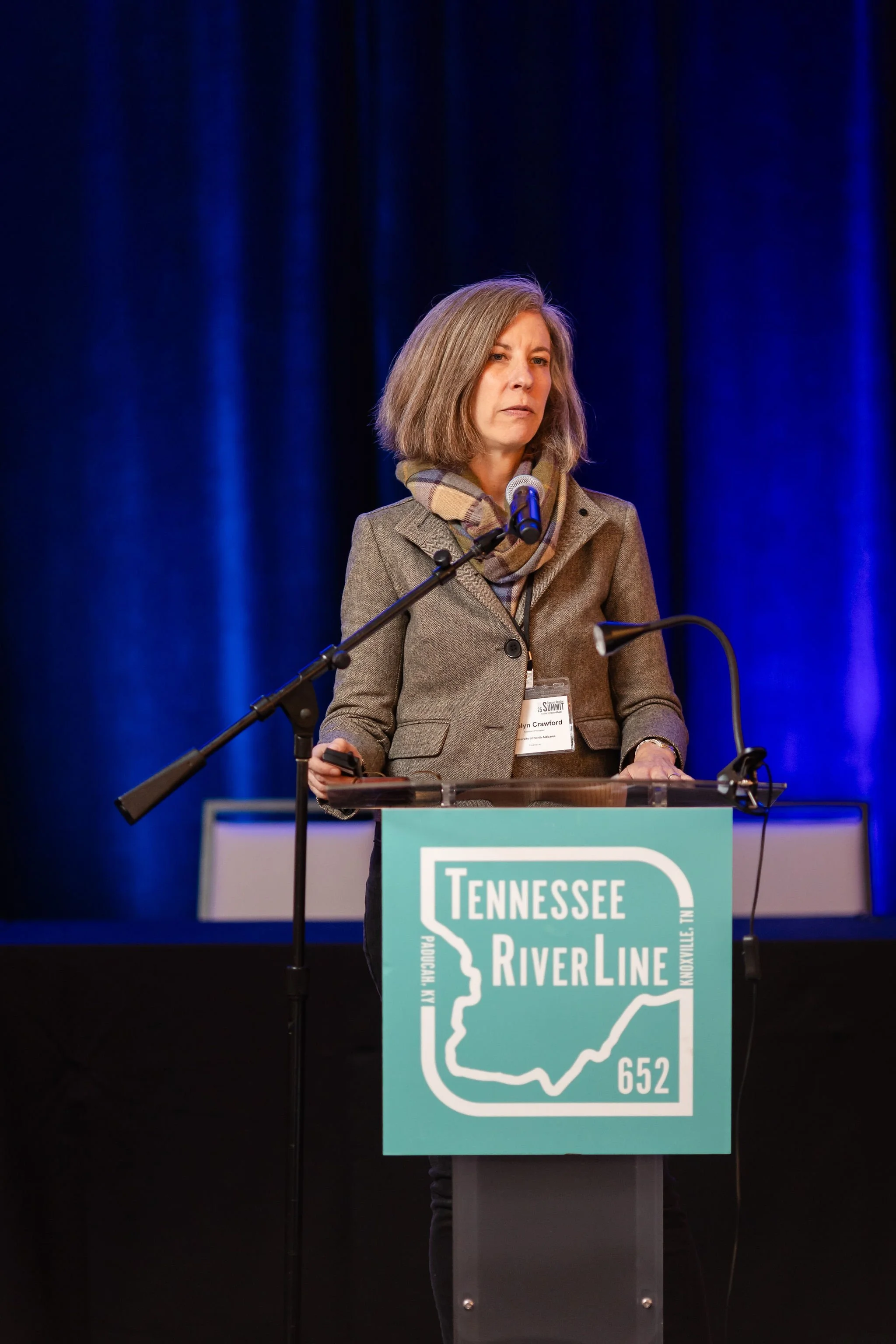
Dr. Crawford takes questions from the audience following her presentation about the history of the Tennessee River at the 2025 Tennessee RiverLine Summit.