
Hellbender Fun Facts: The Giant Salamander of the Tennessee River Watershed
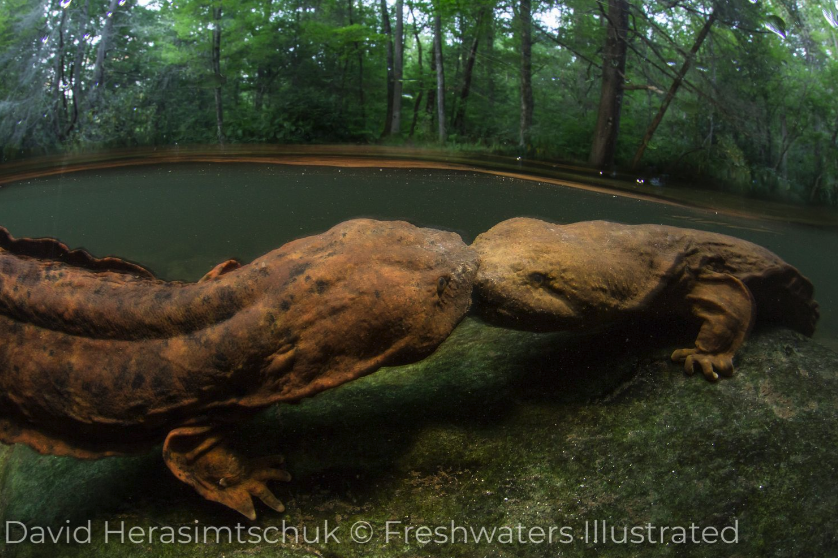
Coming in at a whopping four pounds and able to grow more than two feet long, hellbenders are one of the largest salamanders in the world, and one of the most unique creatures you can find along the Tennessee RiverLine and the Tennessee River Watershed at large.
We want to celebrate the amazing wildlife you can find among the 1.2+ million acres of connected outdoor recreation experiences along the Tennessee RiverLine. After reading this article, you’ll be able to talk your friends’ ears off about one of the wildest and most ancient animals you can find in the watershed: hellbenders!
Hellbenders have lungs that they don’t use to breathe.
There are scientific debates over just how vestigial (essentially useless) this animal’s lungs are, as they are no longer efficient for breathing, but may assist hellbenders with managing buoyancy. They need to move through flowing water to get oxygen into their bloodstream, which bring us to the next fun fact:
They breathe through their skin, which explains all the wrinkles.
Hellbenders, and salamanders in general for the most part, process oxygen through capillaries (blood vessels) very close to their skin. Because of this, they earned a scientific name which translates to “hidden gills:” Cryptobranchus alleganiensis. The layers that are created by the folds in their skin help them catch oxygen from the water and process it, but this also means they are extremely sensitive to contaminants in the water. This sensitivity has put them, and again many other salamanders, at varying risk levels towards extinction due to pollution in the streams they favor.
Hellbenders love cold, clear, rocky water.
You are most likely to find hellbenders in larger streams with quickly-flowing water, especially those with large rocks to hide under, creating a “bed”. This means you are more likely to find one in a tributary than on the main stem of the Tennessee River, which is warmer and slower-moving than the hellbender’s preferred conditions. During the day, they like to hide under rocks and sit mostly still, then they come out at night to begin feeding. Hellbenders wiggle side-to-side with their whole bodies, including their heads as they swim. They kick along rocks in the streambed with their little legs and toes in a way that looks kind of clunky.
The number one environmental impact that is harming Hellbenders is increased mud or sediment in rivers that used to run clear. Watch this short to learn more about how sediment affects Hellbenders
Their ancient lineage explains their strange appearance (they lived among dinosaurs!).
Hellbenders have been around an estimated 150 million years. This means their ancestors have been roaming Earth’s streams since the Late Jurassic period, when many fan-favorite dinosaurs were walking among them, including stegosaurus, brachiosaurus, and archaeopteryx, one of the earliest ancestors of modern birds.
They’ll eat many different things, and they have impressive reflexes.
Hellbenders snag mostly crayfish and small fish at shockingly snappy speeds for their food, but they also have been known to snack on insects, tadpoles, and their own kind when they find the need. Females, which are typically larger than their opposite-sex counterparts, are drawn to nesting sites by males and lay 200-400 eggs during the fall. They prefer to nest along permanent structures like logs and rocks, which is a big part of why you should never, ever (ever!) move rocks around or build rock towers while you are exploring the water.
Males guard the nest, but they also cannibalize it.
Hellbender eggs take about 60 days to hatch, which means they need protection from other animals, as well as other individuals. In fact, right after a female has laid her eggs, the male swoops in to push her away—preventing her from eating the eggs herself—and takes over protective duties until they hatch. However, sometimes a guy gets hungry and he needs to eat his would-be future children. Why else would there be a few hundred to choose from?
Hellbenders live for a relatively long time, and grow up slowly.
The estimated maximum lifespan of a wild hellbender is about 30 years, and some have lived longer than 45 years in captivity. They have relatively long childhood/adolescent periods, as it can take between five and eight years to reach sexual maturity.
Hellbenders are the third largest salamanders in the world.
Behind their “giant salamander” contemporaries in China and Japan, eastern hellbenders make the top three for largest salamander species on the planet. Chinese giant salamanders up to six feet in length have been found in the wild, and they can reach up to 110 pounds! Their Japanese cousins are not far behind, coming in at up to five feet and maxing out at 55 pounds. Strangely enough, many articles cite the fact that Japanese and Chinese giant salamanders smell like pepper, and in Japan their common name translates to “big pepper fish.”
They are referred to by many less-than-affectionate names.
“Hellbender” is already a pretty harsh name since it implies that these creatures are bent on coming back from the underworld. Its other nicknames range from cute to somewhat rude, depending on the region. Some highlights include: snot otter, water dog, devil dog, lasagna lizards, mud devil, mud cat, walking catfish, and Allegheny alligator.
Though these amazing creatures are pretty easy to identify if you’re lucky enough to see one, you may want to snap a pic and upload it to iNaturalist as a part of our iSpy652 project! Your pictures of any wildlife—plant or animal—is critical for researchers to understand the range and preferred habitats of everything that calls the Tennessee River Valley home!
To learn even more about these amazing inhabitants of the Tennessee River Watershed, enjoy this short film from the makers of Hidden Rivers, The Last Dragons!
**Photo courtesy of David Herasimtschuk for Freshwaters Illustrated.